If your bee suit fits like a tailored jacket, you are essentially inviting a sting. Safety in the apiary isn't actually about the thickness of your clothing; it's about the air gap between the material and your skin. This bee suit sizing guide uk explains why that gap is your primary defence against an agitated colony. A honey bee stinger is typically 3mm long, which is why professional BBWear suits are engineered with a 5mm protection layer to keep you out of reach. If the fabric pulls taut when you bend over a hive, that critical safety margin vanishes instantly.
We understand the frustration of restricted movement and the nagging fear of exposed ankles when reaching for a deep frame. You need gear that allows you to work with focus, not equipment that leaves you vulnerable during a routine inspection. By following our professional measurement standards, you'll gain total confidence in your choice of apparel. We'll cover how to account for seasonal layering, why sizing up is a technical requirement rather than a style choice, and how to select a suit that offers maximum protection and comfort in the apiary.
Key Takeaways
- Understand the "Air Gap" principle to ensure your suit neutralises stings by keeping the fabric away from your skin at all times.
- Use this bee suit sizing guide uk to master the measurement process, ensuring you account for the extra layers required during cooler British spring inspections.
- Learn why your standard high street clothing size is a poor indicator of beekeeping safety and how to choose a fit that permits full range of motion.
- Compare the security of one-piece suits against the flexibility of jackets and trousers to find the best match for your specific body proportions.
- Discover why BBWear is the professional benchmark for UK beekeeping, offering the essential balance between maximum airflow and high-level sting resistance.
Why Correct Bee Suit Sizing is Your First Line of Defence
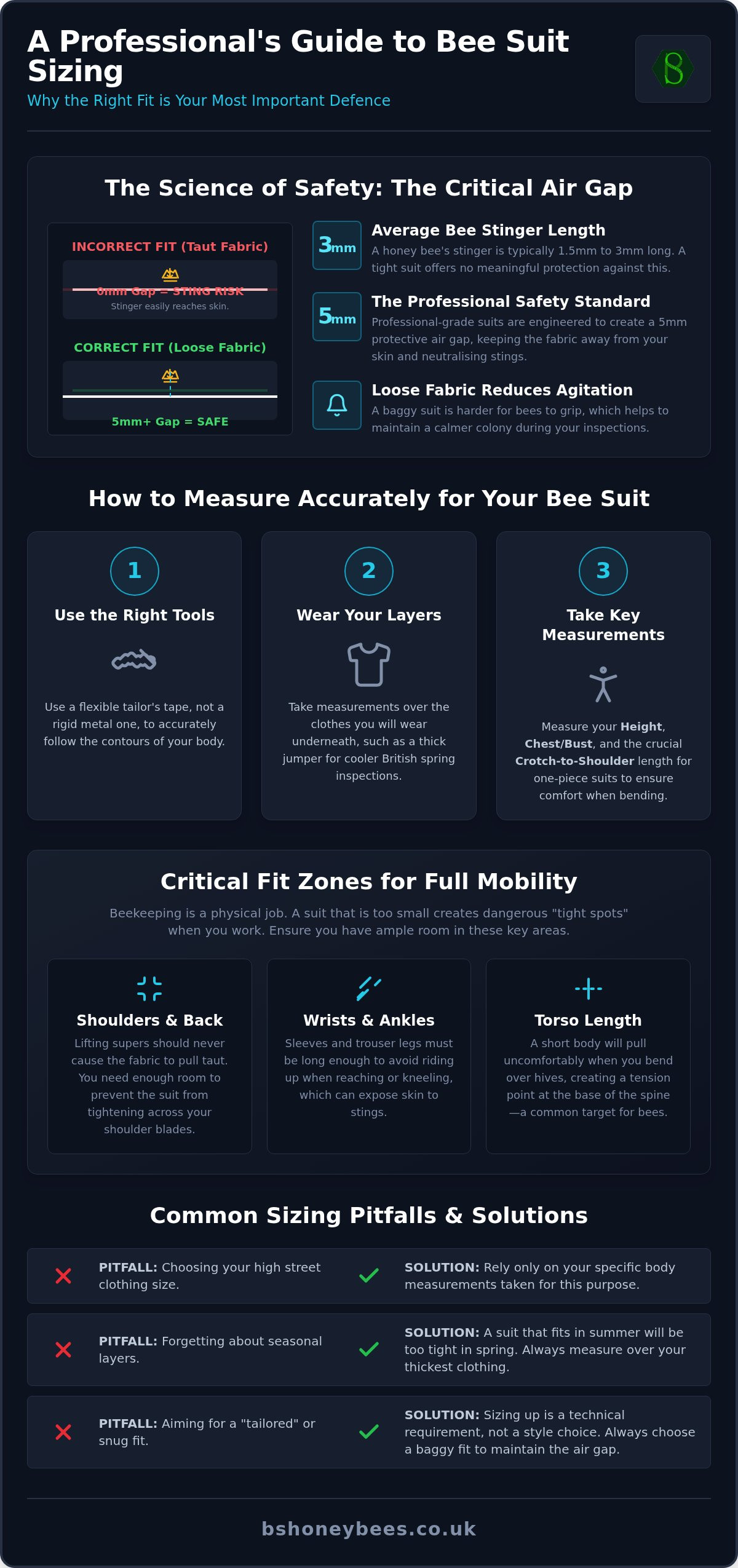
Many beginners assume a bee suit works like a suit of armour, relying solely on the thickness of the material to prevent injury. In reality, the effectiveness of protective clothing for beekeepers relies on an invisible buffer. This "air gap" is the foundation of any reliable bee suit sizing guide uk. If the fabric is pressed tight against your skin, a bee can easily bridge the distance with its stinger. A well-sized suit ensures the material hangs loosely, creating a physical distance that a bee simply cannot penetrate.
Loose fabric also plays a vital role in colony management. When fabric is under tension, it creates a firm surface that bees can easily grip and target. A baggy suit prevents this tension, making it harder for bees to find a "purchase" point on your gear. This reduces bee agitation and helps maintain a calm environment whilst you work. If you feel the material stretching across your back or thighs, you've already lost your primary line of defence.
The Science of the Air Gap
Honey bee stingers typically measure between 1.5mm and 3mm in length. To remain safe, you need a consistent 5mm of air space between the suit's outer layer and your body. This is why professional-grade gear, such as BBWear, is designed with generous proportions. Thick fabric alone isn't the solution; if you choose a size that's too small, your movement will pull the material taut over your shoulders and elbows. This effectively reduces that 5mm gap to zero, allowing a stinger to reach your skin instantly. You need that "buffer" room to account for every twist and turn during an inspection.
Mobility and Safety in the Apiary
Beekeeping is a physical pursuit that requires a full range of motion. When you're managing a British National hive, you'll spend a significant amount of time bending over the brood box or lifting heavy honey supers. These actions naturally stretch the suit and can create dangerous "tight spots" if the sizing is incorrect. Consider these critical areas:
- Shoulders and Back: Lifting a full super shouldn't cause the suit to ride up or tighten across your shoulder blades.
- Wrists and Ankles: Reaching into the hive or kneeling on the ground often causes sleeves and trouser legs to retract. If they're too short, you risk exposing your wrists or ankles to stings.
- Torso Length: A suit that's too short in the body will "dig in" when you bend over your hives, creating a tension point at the base of the spine where bees often congregate.
Ensuring your suit has enough "slop" or extra length in the limbs and torso isn't a matter of style. It's a technical requirement that keeps the protective air gap intact regardless of your posture.
A Step-by-Step Guide to Measuring for Your UK Bee Suit
To begin using this bee suit sizing guide uk, you must first put away the metal DIY tape measure. Metal tapes are designed for rigid timber and flat surfaces; they don't follow the contours of your body accurately. Instead, use a flexible tailor's tape to get precise, wrap-around figures. It's also vital that you take these measurements whilst wearing your typical beekeeping clothes. If you intend to wear a thick woollen jumper during chilly April inspections, your measurements must account for that extra bulk. Ignoring this "layering factor" is the fastest way to end up with a suit that feels like a straitjacket in the field.
For those opting for a one-piece suit, height is your most critical metric. However, don't ignore the "crotch-to-shoulder" measurement. This specific dimension determines how much "give" you have when bending over a hive. If the torso is too short, you'll experience uncomfortable tension every time you reach for a frame. This restriction doesn't just impact comfort; it pulls the fabric taut against your back, compromising your protection. If you're looking for gear designed with these ergonomic needs in mind, you might browse our selection of professional BBWear suits to see how they accommodate the active beekeeper.
Taking Accurate Body Measurements
Accuracy at this stage prevents the hassle of returns later. Follow these three steps for the best results:
- Height: Stand straight against a wall without shoes. Measure from the crown of your head to the floor. This is the primary anchor for suit sizing.
- Chest or Bust: Wrap the tape around the fullest part of your chest, keeping it level under your arms. Breathe naturally; don't hold your breath or puff out your chest.
- Inside Leg: Measure from the crotch to the ankle bone. Crucially, you should add 2 to 3 inches to your standard trouser length. This extra length ensures that when you kneel to check a bottom board, the suit doesn't ride up and expose your ankles to stings.
The "Sitting Test" for Sizing Accuracy
Once you've compared your numbers to a chart, always lean towards the larger size if you're between brackets. A Beginner's Guide to Beekeeping Clothing often points out that a suit that feels "just right" whilst standing will likely fail the mobility test in the apiary. Perform a "sitting test" by mimicking a deep crouch. Check for any pulling across the thighs or the lower back. Pay close attention to the veil; if leaning forward causes the mesh to touch your nose or chin, the torso is too short. Any contact between the mesh and your face is a major safety risk, as bees can sting through the veil if it's pressed against your skin.
Comparing Styles: Full Suits vs Jackets and Trousers
Choosing the right style is just as important as getting the measurements right. In this bee suit sizing guide uk, we look at how your physical build should influence your choice between a one-piece or a two-piece set. While a one-piece provides a total seal, it can be unforgiving if your proportions don't match the standard "average" build. If you have a particularly long torso or short legs, you might find a full suit restrictive in ways a jacket and trouser combination simply isn't.
Two-piece sets offer a significant advantage for "non-standard" body types. You can pair a large jacket with medium trousers, ensuring both halves fit comfortably without excess fabric catching on hive components. However, the "overlap" is the critical safety zone. You must ensure the jacket hem sits well below the waistline, even when you're reaching for the top bars. To ensure the overlap remains sting-proof, look for these specific features:
- Extra Long Hems: The jacket should reach mid-thigh when your arms are at your sides to prevent riding up.
- High-Waisted Trousers: Beekeeping trousers should sit higher than standard jeans to maximise the crossover area.
- Robust Elastic: The waistband must remain snug against the trousers even when you're twisting or bending over the brood box.
When to Choose a Full Bee Suit
For total peace of mind, a full bee suit with veil is the industry standard. We recommend this style for beginners who might be less confident in their movements around the colony. It eliminates the worry of a jacket riding up and provides a psychological boost of "total" protection. Managing the heat in a full suit requires smart fabric choices, but the security of knowing there are no seams for a bee to crawl through is often worth the extra warmth during a summer honey flow.
The Flexibility of Beekeeping Jackets
Jackets are ideal for experienced keepers performing quick inspections or harvesting honey. They're faster to put on and offer better ventilation for the lower body if you're wearing standard trousers. When sizing a jacket, always check the elasticated waist. It should be firm enough to stay in place but loose enough to allow the "air gap" we discussed earlier. Pair your jacket with dedicated beekeeping trousers that feature elasticated ankles and stirrups to maintain a complete seal against the ground. This modular approach allows you to adapt your gear to the specific task and the current British weather.
Common Sizing Pitfalls and How to Avoid Them
Don't fall into the "High Street Size" trap. This is the most frequent error we see in any bee suit sizing guide uk. Your regular clothing size is based on fashion and aesthetics; beekeeping gear is based on technical clearance. A medium jacket from a retail shop is designed to sit close to the body. A medium bee suit must accommodate your frame plus a significant volume of air. If you order based on your trouser size, you'll likely find the suit restrictive the moment you attempt to lift a heavy brood box.
The British climate demands versatility. When you're performing early spring inspections or introducing mated queen bees UK, the temperature often requires a thick fleece or gilet. If your suit doesn't account for this "Spring Jumper" factor, you'll be forced to choose between being cold or being poorly protected. A suit that is too tight over layers loses its sting-proof air gap. Conversely, avoid the urge to buy a suit three sizes too large. Excessively baggy fabric creates "snag points" that can catch on hive corners or cause you to trip whilst carrying equipment. Balance is essential.
Seasonal Layering Considerations
Choose a suit that offers enough room for a thermal layer without becoming cumbersome during the July heat. Managing this transition is easier if you look for suits with adjustable elasticated waists. These allow you to cinch the fabric in summer for better airflow and loosen it in spring to accommodate bulkier clothing. Maintaining that 5mm buffer is non-negotiable regardless of the month. You can view our range of BBWear suits to find models that offer this essential adjustability.
Footwear and Glove Integration
Your choice of footwear directly impacts your leg length requirements. Most UK beekeepers wear wellies or sturdy leather boots. If your suit legs are too short, they'll pull up over the top of the boot when you kneel, leaving your calves exposed. Always measure your inside leg whilst wearing your boots to ensure the elasticated hem stays securely in place. Similarly, pay attention to the wrist seals. Professional suits feature thumb loops to prevent sleeves from riding up the arm when you're reaching into the hive. This ensures a continuous, sting-proof seal between your sleeve and your beekeeping gloves at all times.
Choosing Premium Protection: Why BBWear Standards Matter
Selecting the correct dimensions from a bee suit sizing guide uk is only the first step; the second is ensuring the garment you choose can maintain those safety margins over years of use. Amongst experienced UK keepers, BBWear is the industry benchmark for a reason. These suits are handcrafted in Cornwall and engineered to meet the specific ergonomic demands of managing British apiaries. Whilst cheaper imports often lose their shape after a few washes, a premium suit is designed to retain its structure, ensuring that the 5mm air gap we discussed earlier remains consistent throughout the garment's life.
The difference lies in the technical standards of the fabric. BBWear suits are certified as Personal Protective Equipment (PPE), conforming to rigorous UK and EU regulations. This isn't just about thickness; it's about the balance between sting resistance and breathability. For example, the Ultra Bee Suit fabric offers 100% porosity for maximum airflow, which is a massive leap from the 12.2% airflow found in standard poly-cotton blends. This allows you to stay cool during a heavy summer honey flow without sacrificing the 5mm protection standard that neutralises a bee's 3mm stinger. When your gear is sized correctly, these high-tech materials work with your body rather than against it.
The BBWear Advantage
One of the most significant benefits of a BBWear bee suit is the specialised hood and veil design. Many generic suits have veils that collapse or shift, but BBWear uses a structured design that maintains excellent visibility whilst keeping the mesh away from your face. The zips are robust and feature secondary seals to prevent any opportunistic bees from finding an entry point. These design choices reflect a deep understanding of hive management, where a split-second distraction from a poorly fitted veil can lead to a lapse in safety.
Investing in Your Safety
Price should always be secondary to fit and protection when you're dealing with live colonies. A suit that lasts 15 years or more is a far better investment than a budget option that needs replacing after two seasons of snagging and shrinking. Before you place your order with a specialist, run through this final checklist to ensure total confidence in your choice:
- Layering: Have you measured whilst wearing the thickest jumper you intend to use?
- Height: Is the torso length sufficient to prevent the suit "digging in" when you bend over the brood box?
- Limbs: Did you add the necessary 2 to 3 inches to your inside leg to account for kneeling?
- Movement: Have you performed a "sitting test" to check for tension points at the knees and shoulders?
By prioritising these professional standards, you ensure that your time in the apiary is defined by focus and enjoyment rather than the constant worry of a sting. Professional gear doesn't just protect you; it provides the confidence required to manage your bees with a calm and steady hand.
Secure Your Confidence in the Apiary
Mastering the technical details within this bee suit sizing guide uk ensures you can manage your colonies without the constant distraction of a compromised protective buffer. Safety in the apiary is built on precision; choosing a suit that permits seasonal layering and a full range of motion is your best defence against stings. By prioritising accurate height and inside leg measurements, you eliminate the risk of exposed skin during vital hive inspections.
As an official BBWear stockist, we provide the professional-grade protection trusted by expert bee breeders across the country. Our team offers dedicated UK-based beekeeping support to help you navigate the nuances of sizing and style with ease. We understand that the right fit is the difference between a stressful inspection and a successful one.
Browse our range of professional BBWear bee suits and find your perfect fit to ensure you're fully protected for the season ahead. With the correct fit secured, you can focus entirely on the health and productivity of your bees, knowing your gear is technically sound and built to last.
Frequently Asked Questions
Should I buy a bee suit one size larger than my normal clothes?
Yes, you should almost always select a size larger than your standard high street clothing. This bee suit sizing guide uk emphasises that a tight fit compromises the essential air gap required to neutralise a 3mm stinger. Sizing up ensures you have sufficient room for a thick fleece during early spring inspections without the fabric pulling taut against your skin. A generous fit also prevents the suit from riding up whilst you work.
What is the most important measurement when choosing a beekeeping suit?
Height is the most critical metric for one-piece suits as it determines the overall torso length. If the suit is too short in the body, it will restrict your movement when bending over a hive, creating dangerous tension points. You must also prioritise the crotch-to-shoulder measurement to ensure you can reach for heavy honey supers comfortably. Accurate height ensures the protective hood and veil sit correctly without pulling against your face.
How do I know if my bee suit is too small?
Your suit is too small if the fabric pulls tight across your shoulders, back, or thighs when you crouch. Perform a "sitting test" to check for tension; any restriction in movement indicates a lack of the necessary protective air gap. Additionally, if the veil mesh touches your nose or chin when you lean forward, the torso length is insufficient. This contact is a major safety risk, as bees can sting through the mesh.
Can I wear a bee suit if I am very tall or have a large build?
Absolutely, professional beekeeping gear is designed to accommodate a wide variety of body types. If you have a very tall or large build, following a bee suit sizing guide uk will help you choose between a one-piece or a modular jacket and trouser set. This modular approach allows you to select different sizes for the top and bottom, ensuring maximum comfort and protection. Professional standards cater to all ergonomic requirements in the apiary.
Do I need to account for my boots when measuring my inside leg?
You must account for your footwear by adding approximately 2 to 3 inches to your standard inside leg measurement. Beekeepers frequently kneel or crouch during hive inspections, which causes the suit legs to ride up. If you don't include this extra length, the elasticated hem may pull above the top of your wellies, leaving your ankles vulnerable to stings. Measuring whilst wearing your boots is the best way to ensure a continuous, secure seal.
Is a jacket and trouser set as safe as a full bee suit?
A jacket and trouser set is highly effective provided there is a substantial overlap at the waist. The jacket hem should reach mid-thigh to prevent it from riding up when you reach for frames. Whilst a one-piece suit offers a total seal, a well-fitted two-piece set provides better flexibility for those with non-standard proportions. Ensure the elasticated waistband is robust enough to maintain a firm closure against the trousers at all times.
What should I wear underneath my bee suit for the best fit?
Choose lightweight, breathable cotton layers for summer inspections to prevent overheating whilst maintaining the air gap. During cooler months, you'll need room for a thick fleece or thermal jumper. It's vital to take your measurements whilst wearing these bulkier items to ensure the suit remains comfortable year-round. Avoid wearing denim or heavy fabrics that restrict your range of motion; the goal is to move freely without creating tension in the protective material.
How much room should there be between my face and the veil?
There should be at least 5mm of clear space between your face and the veil mesh at all times. This gap is your primary defence, as a honey bee's stinger cannot reach your skin across this distance. If the veil shifts or touches your face when you move, the suit is likely too small or the hood is poorly adjusted. Professional hoods are designed to remain structured, ensuring the mesh stays safely away from your nose.